Financing Biodiversity in Urban Areas: challenges, opportunities, and an overview of funding sources in the FIRE platform
 Email
Email Linkedin
 Bluesky
 Mastodon
By Guilherme De Franco
While biodiversity conservation is often associated with remote forest reserves and protected areas, urban spaces also play a key role in protecting biodiversity, contributing to residents’ wellbeing and for climate mitigation and adaptation within cities. For example, 190 plant species and more than 100 animal species share Cape Town's municipal area with 5 million people, demonstrating the effectiveness of urban conservation efforts[3]. In addition, urban nature-based solutions (NbS) such as green roofs and walls have the potential to reduce energy consumption for cooling and heating, mitigate the urban heat island effect, and diminish flood risk from stormwater runoff. Other NbS such as urban parks and forests can improve water quality, CO2 storage, and habitat conservation. Finally, nature-based draining systems and similar green-blue infrastructure can mitigate flood risk while providing recreational spaces for residents[].
Solutions like these are essential to continue transforming cities from nature-negative to nature-positive spaces. Urban growth has been a key driver of biodiversity degradation, causing the loss of 190,000 km² of natural habitat between 1992 and 2000, and is projected to result in the loss of additional 290,000 km² by 2030[5]. On the other hand, the Kunming-Montreal Global Biodiversity Framework recognizes the importance of strengthening green spaces and biodiversity-positive urban planning (Target 12)[6] for conservation and restoration. Therefore, cities are not only drivers of biodiversity loss, but also sources of solutions.
Financing biodiversity in urban areas
Similar to other biodiversity conservation and restoration initiatives, protecting and enhancing urban biodiversity requires financial resources. The United Nations Environment Programme (UNEP) estimates a US$ 542 billion global nature finance gap by year for this decade[7]. Moreover, subnational and local governments often face even greater challenges in accessing available biodiversity funding opportunities when compared to national governments and private actors, due to characteristics in both the demand for and supply of finance.
On the demand side, many cities in low- and middle-income countries are not included in credit ratings, therefore lacking creditworthiness and encountering barriers in accessing debt mechanisms. Furthermore, limited technical capacity among public servants has hindered the preparation of bankable projects that meet funding organizations’ requirements, as well as cities’ ability to develop innovative financial mechanisms. For example, by 2023, just approximately one-third of the 100 largest cities in developing countries had issued municipal bonds[8].
On the supply side, existing funding opportunities often do not consider subnational and local governments as eligible applicants or are not tailored to address their specific needs[9], such as capacity building assistance, de-risking mechanisms, or grants with catalytic purpose.
Despite these challenges, local and subnational governments across the world have shown significant interest in driving climate and biodiversity action in their territories and participating in global discussions and negotiations. For example, Regions4 launched in 2002, is a global network that brings together subnational governments on the front lines of climate action, biodiversity protection, and sustainable development. Today, Regions4 represents 56 members, including 10 regional associations across 24 countries, collectively representing more than 143 regions and impacting more than 215 million people. Officially recognized by UN bodies such as the UNFCCC, the CBD, and UNDP, Regions4 ensures that regional perspectives shape global decision-making. Through its official observer status, strategic partnerships, and accreditation to key international forums, Regions4 provides subnational governments with direct access to high-level negotiations and meaningful opportunities to influence policies on climate, nature, and sustainable development[10]. Additionally, the organization is a partner of the Finance Resources for Biodiversity (FIRE) platform that have dedicated opportunities for urban biodiversity.
Considering the barriers subnational and local governments face to access finance for urban biodiversity, the Finance Resources for Biodiversity (FIRE) platform of the United Nations Development Programme is a valuable tool to find funding opportunities. Through the platform, users can filter for “Towns & Municipalities”, “Subnational Governments” and “Human-modified ecosystems” viewing only the opportunities that match these criteria. Examples include the City Climate Finance Gap Fund, the Global Ecosystem-based Adaptation (EbA) Fund, and the EU LIFE Programme.
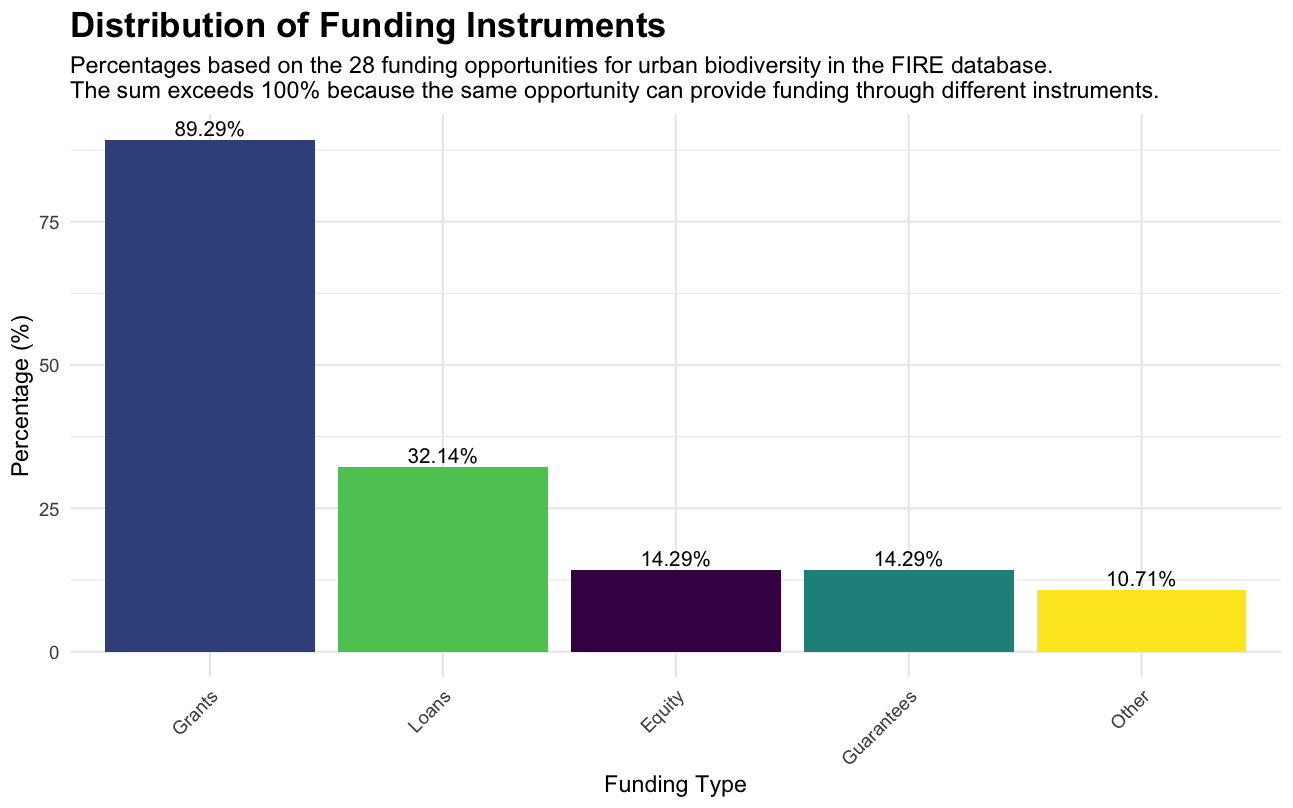
By end of 2025, FIRE contained 28 funding opportunities for human-modified ecosystems that subnational governments, towns, and municipalities can apply for. Of these, 89.3% offer grants, while 32.1% provide loans. The predominance of grants aligns with the technical support and catalytical assistance that urban funding opportunities usually provide.
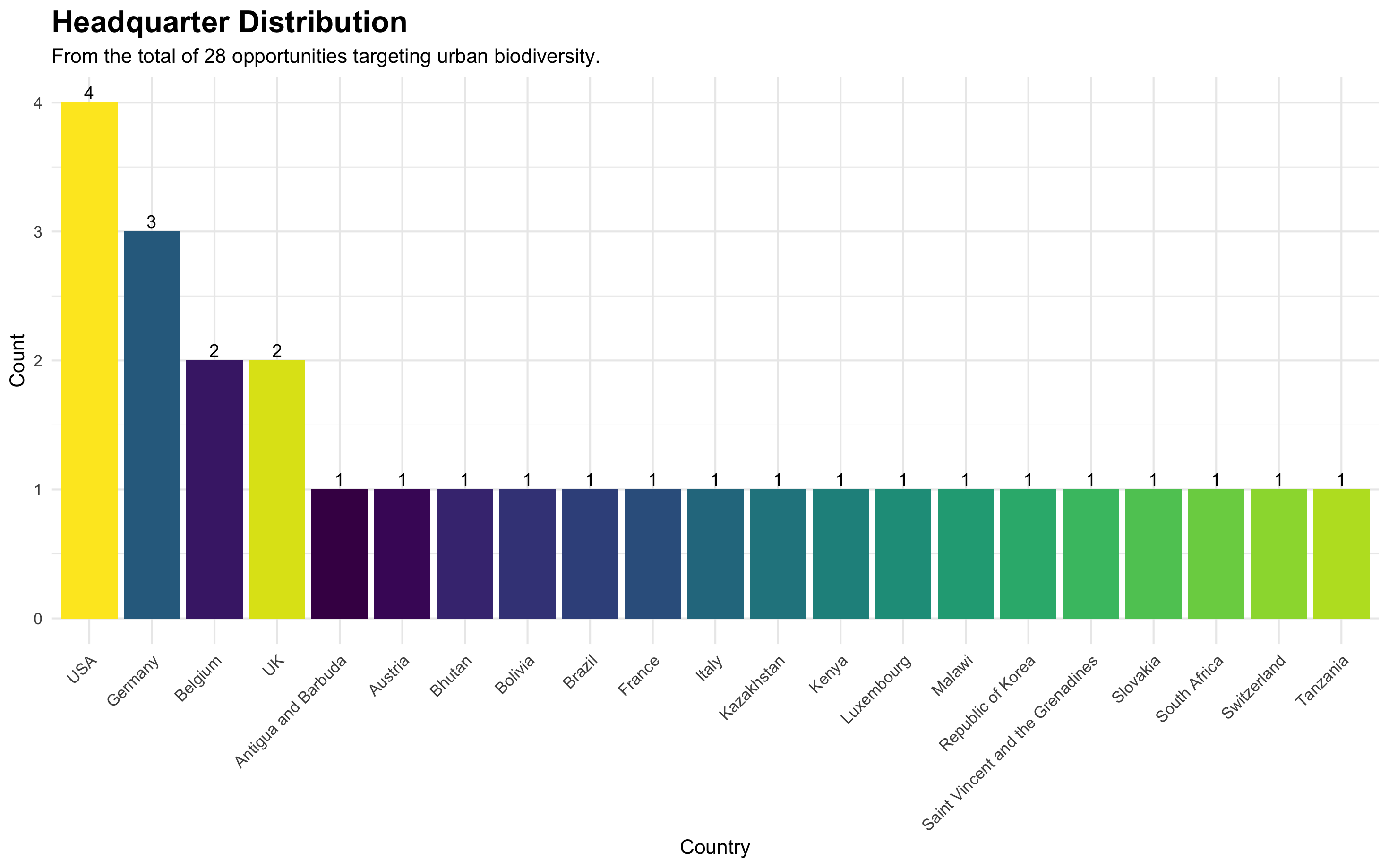
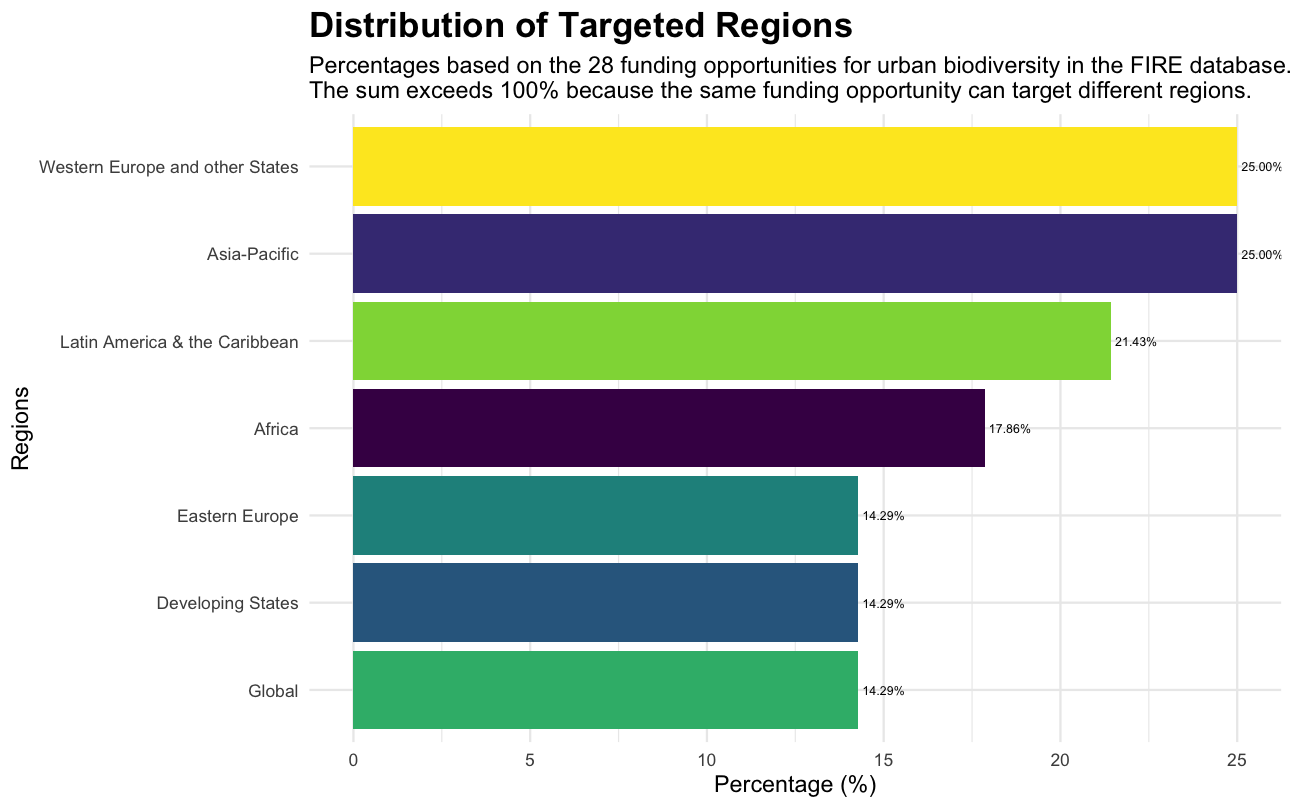
25% of the opportunities explicitly target the United States, Canada, and Western Europe. At least one country in Asia, Latin America & the Caribbean, and Africa is mentioned in 25%, 21.4% and 17.9% of the opportunities, respectively. 14.3% of them mention having a global scope. The same percentage applies to opportunities explicitly covering developing states (in general terms)[11], and to those covering at least one country in Eastern Europe.
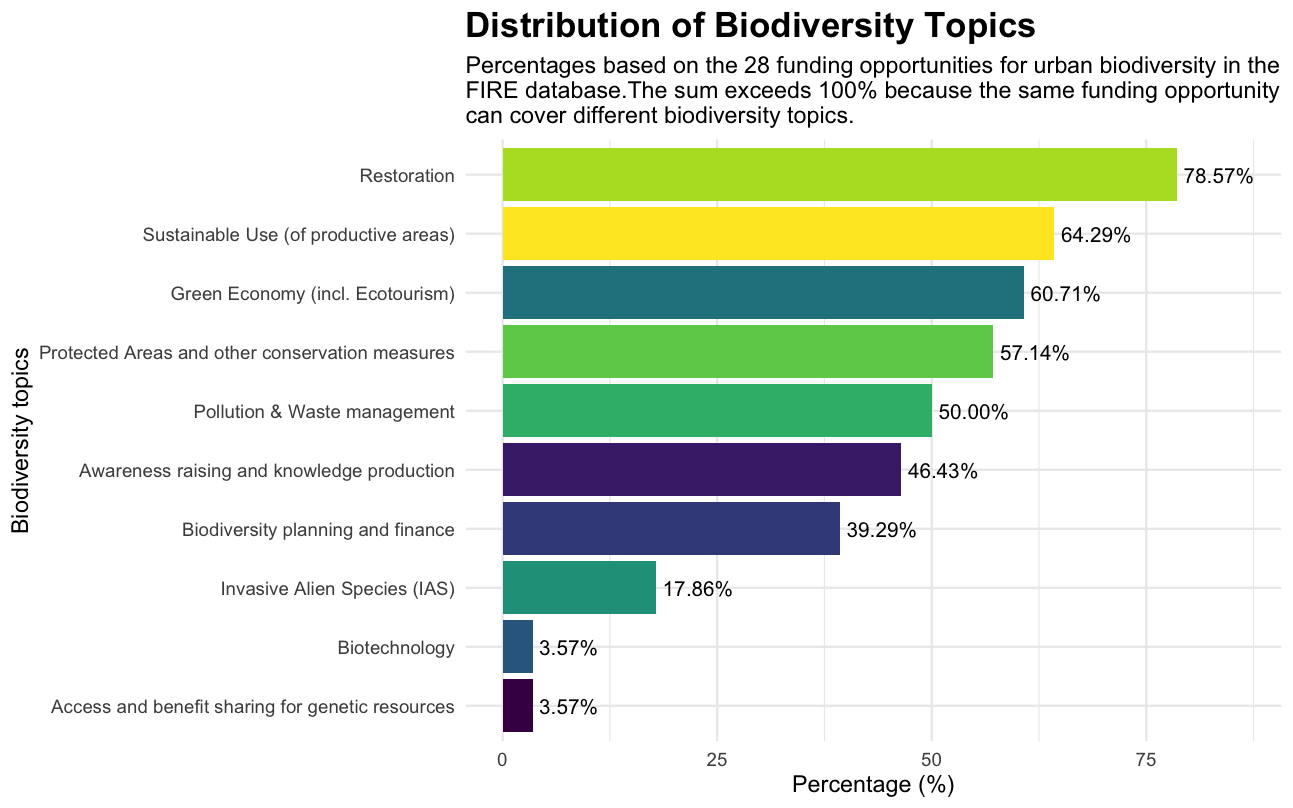
Key biodiversity topics supported are restoration (by 78.6% of the opportunities), sustainable use of protected areas (64.3%), green economy (60.7%), conservation measures (57.1%), and pollution and waste management (50%).
Lastly, 42.9% of the opportunities provide funds in the US$5,001–20,000 tranche, 42.9% cover the US$20,001–50,000 range, and 39.3% offer support in the US$50,001–150,000 range. It is important to note that the sum of these percentages exceeds 100%, as the same funding opportunity may offer support across multiple funding-size tranches.
References
- Baker, K., Kochar, R., Ndamandama, M., den Hertog, R. G., & Waldraff, C. (2023). Investing with Nature: Exploring Investment Opportunities Across Ecosystems, Primer 6: Nature-based Solutions in Urban Areas. United Nations Environment Programme Finance Initiative. Nairobi.
- Convention on Biological Diversity. (2022). Kunming-Montreal Global Biodiversity Framework. https://www.cbd.int/gbf
- Guerry, A.D., Smith, J.R., Lonsdorf, E., Daily, G.C., Wang, X., & Chun, Y. (2021). Urban Nature and Biodiversity for Cities. Policy Briefing. Global Platform for Sustainable Cities, World Bank. Washington, DC. © World Bank. https://www.thegpsc.org/sites/default/files/final_urban_nature_and_biodiversity_for_cities.pdf
- Lwasa, S., Seto, K.C., Bai, X., Blanco, H., Gurney, K.R., Kılkış, Ş., Lucon, O., Murakami, J., Pan, J., Sharifi, A., & Yamagata, Y. (2022). Urban systems and other settlements. In P.R. Shukla, J. Skea, R. Slade, A. Al Khourdajie, R. van Diemen, D. McCollum, M. Pathak, S. Some, P. Vyas, R. Fradera, M. Belkacemi, A. Hasija, G. Lisboa, S. Luz, & J. Malley (Eds.), Climate Change 2022: Mitigation of Climate Change. Contribution of Working Group III to the Sixth Assessment Report of the Intergovernmental Panel on Climate Change. Cambridge University Press, Cambridge, UK and New York, NY, USA. https://doi.org/10.1017/9781009157926.010
- McDonald, R. I., Colbert, M. L., Hamann, M., Simkin, R., & Walsh, B. (2018). Nature in the urban century: a global assessment of where and how to conserve nature for biodiversity and human wellbeing. The Nature Conservancy. https://www.nature.org/content/dam/tnc/nature/en/documents/TNC_NatureintheUrbanCentury_FullReport.pdf
- Regions4. (n.d.). About us. https://regions4.org/about-us/regions4/
- Regions4. (n.d.). What we do. https://regions4.org/our-work/what-we-do/
- United Nations Department of Economic and Social Affairs (2018). 68% of the World Population Projected to Live in Urban Areas by 2050. New York. https://www.un.org/uk/desa/68-world-population-projected-live-urban-areas-2050-says-un
- United Nations Environment Programme (2023). State of Finance for Nature: The Big Nature Turnaround – Repurposing $7 trillion to combat nature loss. Nairobi. https://doi.org/10.59117/20.500.11822/44278
- World Bank Group (2025). Unlocking Subnational Finance: Overcoming Barriers to Finance for Municipalities in Low- and Middle-Income Countries. Washington, DC. © World Bank. https://openknowledge.worldbank.org/server/api/core/bitstreams/646266d5-ed42-4d59-a4c7-c9958e2fb0d9/content
Footnotes:
1 United Nations Department of Economic and Social Affairs (2018)
2 Lwasa et al. (2022)
3 Helme and TinderSmith, 2006; Cape Nature, 2011; Holmes et al., 2012, cited in Guerry et al.(2021)
4 Baker et al. (2023)
5 McDonald et al. (2018)
6 Target 12 - Enhance Green Spaces and Urban Planning for Human Well-Being and Biodiversity: Significantly increase the area and quality, and connectivity of, access to, and benefits from green and blue spaces in urban and densely populated areas sustainably, by mainstreaming the conservation and sustainable use of biodiversity, and ensure biodiversity-inclusive urban planning, enhancing native biodiversity, ecological connectivity and integrity, and improving human health and well-being and connection to nature, and contributing to inclusive and sustainable urbanization and to the provision of ecosystem functions and services.
Convention on Biological Diversity: Kunming-Montreal Global Biodiversity Framework. https://www.cbd.int/gbf
7 United Nations Environment Programme (2023)
8 World Bank Group (2025)
9 World Bank Group (2025)
10 Regions4
11 Terms include “Developing countries”, “Official Development Assistance (ODA) eligible countries”, and “Lower-Middle income economies”.