A Guide for Youth-led Biodiversity Projects
 Email
Email Linkedin
 Bluesky
 Mastodon
This guide is designed to support youth seeking biodiversity funding opportunities by equipping them with knowledge about the types of opportunities available on the FIRE platform and offering guidance on how to get involved in biodiversity-related projects.
By Derya Ekin and Deniz Dutton
“Humanity depends on the boundless energy, ideas and contributions of youth everywhere. Today and every day, let’s support and stand with young people in shaping a just and sustainable world, for people and planet” - UN Secretary-General António Guterres
Agents of Change
Youth play a vital role in biodiversity conservation, as the generation who will inherit the planet's current environmental conditions. Increasingly, young people are demonstrating a willingness and capacity to tackle biodiversity loss through innovative ideas, community action, and bold advocacy for transformative policy and systemic change (Geneva Environment Network).
Youth are heavily involved in advocacy efforts through groups like the Global Youth Biodiversity Network (GYBN), established in 2010, as a youth-led coordination platform within the UN Convention on Biological Diversity (CBD). This platform convenes an alliance of youth groups and individuals from over 140 nations with the shared goal of preventing biodiversity loss and ensuring the inclusion of youth perspectives in global biodiversity negotiations. They aim for effective consultation and participation in relation to the goals of the Kunming-Montreal Global Biodiversity Framework (GBF) and their respective countries’ National Biodiversity Strategy and Action Plans (NBSAPs). Through consultations, the following three main youth priorities were identified and are brought to the policymakers to integrate them into policy formulation and implementation to better address the specific needs and concerns of youth:
- Intergenerational equity and youth participation
- Transformative education
- Rights-based approaches for people and nature
To this end, more tools are needed to increase the capacity of youth and youth-led groups to not only advocate for more funding tailored to their needs, but also to identify and apply for existing funding.
Youth Opportunities on FIRE
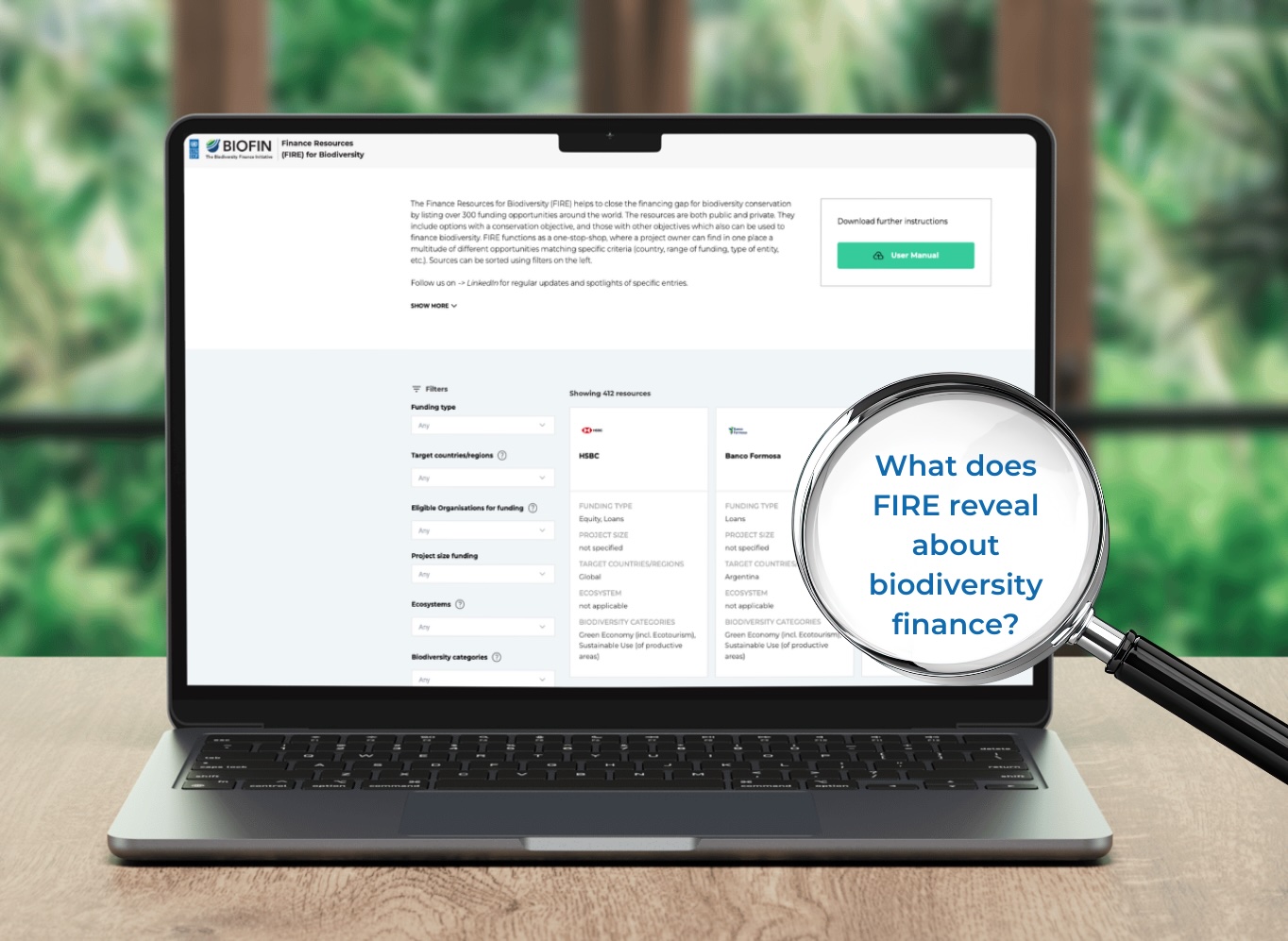
 On the FIRE platform, users can search directly for funding opportunities that are specifically targeted toward youth, by filtering this option under the advanced search option “Particular consideration of”.
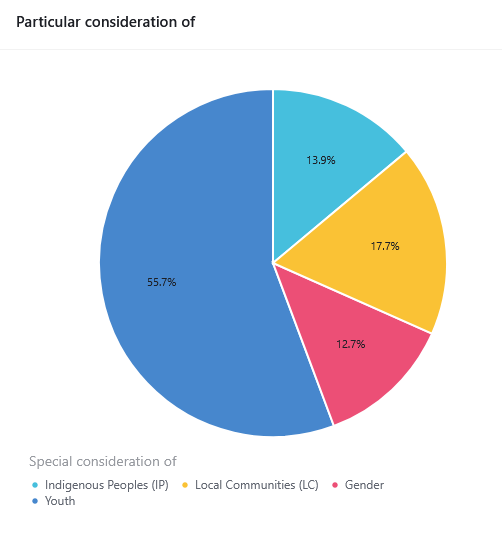 About 20% of funding opportunities found on FIRE explicitly recognize youth as priority applicants for biodiversity-related grants. This is a small, but meaningful share of the biodiversity-related funding landscape on FIRE. Out of all the entries that consider the rightsholder Indigenous Peoples, Local communities, women and youth, youth make up the lion’s share of the opportunities at almost 56%. As youth become increasingly recognized as important contributors, this proportion will likely grow (Sithole et al.).
Currently, most of the biodiversity funding opportunities open to youth on FIRE are related to education, awareness, and small-scale grants, providing young people with foundational experiences in conservation and capacity-building. These programs often support workshops, training initiatives, student-led research, and community-based projects, which allow youth to develop a deeper knowledge of biodiversity issues and practical skills on how to solve them. Fellowship and leadership programs enable young conservationists to take on project management roles and lead field research, empowering youth to contribute meaningfully to biodiversity conservation while strengthening their own professional development.
One example of a youth-oriented opportunity available on FIRE, is the Gustavo Fonseca Youth Leadership Program, honoring the late Director of Programs at the Global Environment Facility (GEF), through fellowships that enhance the skills and capacities of young conservationists in developing countries. The aim is to strengthen university-level education and support field research projects focused on species conservation.
In this program, among many available opportunities on the FIRE platform, particular emphasis is placed on empowering young women in biodiversity conservation. Its selection process is highly cognizant of maintaining gender balance, and forty percent of conservationists supported by the Fonseca program are women (Fonseca).Other opportunities on the platform also prioritize inclusion across intersectional identities such as race and representation from the Global South, ensuring that diverse perspectives are integrated into conservation efforts. For example, the UN Decade on Ecosystem Restoration Youth Task Force (YTF), offers microgrants to support youth-led initiatives that restore and rehabilitate ecosystems globally. The YTF prioritizes the Global South, allocating eighty percent of its funding pool to initiatives based in these countries.
The ASEAN Youth Biodiversity Programme is another youth-focused organization based in the Global South and affiliated with GYBN. They offer a year-long Youth Biodiversity Leader Fellowship Programme as well as 1-6 month internship placements in ASEAN protected areas.
Another opportunity listed on FIRE is the Conservation Leadership Program's Future Conservationist Award, which provides early-career conservationists an opportunity to lead biodiversity conservation efforts in under-resourced parts of the world. This Award provides mentorship, training, and up to USD $15,000 in grant funding, enabling young leaders to turn conservation ideas into action.
Finally, The Rufford Foundation funds field work associated with Masters and PhD projects with a clear conservation benefit in eligible countries, using a tiered funding model ranging from GBP £7,000 to GBP £18,000 depending on whether the applicant has applied before and shown measurable progress in their project.
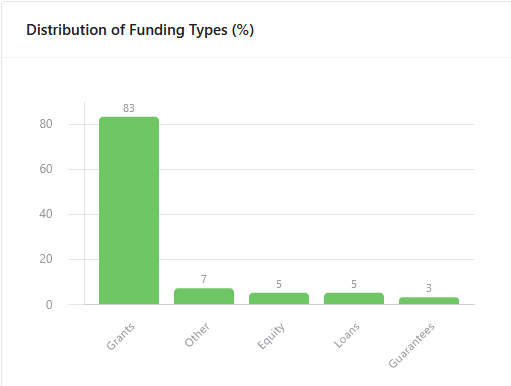 Overall, most funding for youth in FIRE is in the form of grants, at 83%, followed by Equity and Loans, at 5% each.
Funding opportunities for youth in the FIRE database are largely global in nature, with about 10% of the opportunities being available to youth based anywhere in the world. In terms of targeted nationalities, Rwanda, Uganda and the United States are tied with one another at 1.77% of the overall opportunities for youth, followed by Kenya at 1.27%.
Overall, most funding for youth in FIRE is in the form of grants, at 83%, followed by Equity and Loans, at 5% each.
Funding opportunities for youth in the FIRE database are largely global in nature, with about 10% of the opportunities being available to youth based anywhere in the world. In terms of targeted nationalities, Rwanda, Uganda and the United States are tied with one another at 1.77% of the overall opportunities for youth, followed by Kenya at 1.27%.
The biodiversity topics that funding for youth is earmarked for range from 23% for biodiversity awareness-raising activities and knowledge production, followed by 18.8% for wildlife and endangered species and 17.2% for protected areas and other conservation measures. Youth-led restoration is another hot topic at 12.2% of the total.
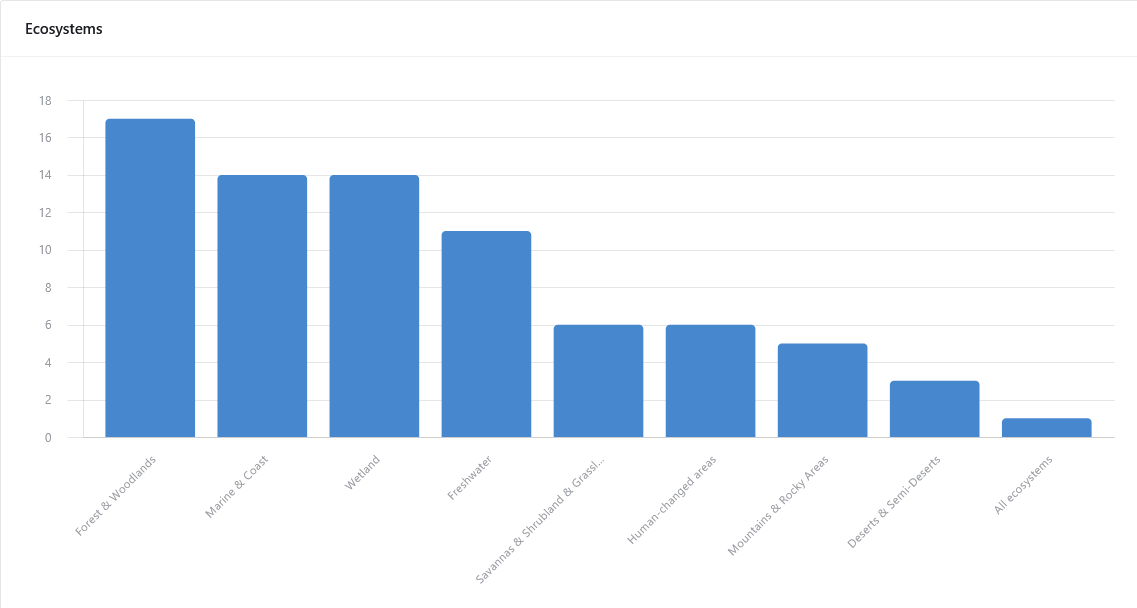
Lastly, most opportunities for youth in the FIRE database are designated for activities in forests and woodlands (21.2%), followed by wetlands and marine and coastal areas (both 17.6%) and freshwater ecosystems (14.1%). Opportunities may target multiple different ecosystems as well, so if you’re a youth on the lookout for funding opportunities, make sure to select as many ecosystems as you think would be relevant. Stacking criteria in the FIRE database has the effect of broadening rather than narrowing the search, so make sure you read the specific criteria of each relevant opportunity to understand what it is funding.
In conclusion, youth are far from a homogeneous or fixed category. When positioned as dynamic “social shifters”, they have the potential to shape global objectives while driving meaningful change at national and local levels (Orsini & Duque). Youth from all backgrounds are thus encouraged to use FIRE to explore opportunities that match their specific skills, experiences, and interests in the biodiversity space.
References
- Convention on Biological Diversity: Global Youth Biodiversity Network. https://www.cbd.int/youth/gybn.shtml
- Geneva Environment Network, Youth and the Environment, 2025. https://www.genevaenvironmentnetwork.org/resources/updates/youth-and-the-environment/
- Global Environment Facility, Fonseca Leadership Program, n.d. https://www.thegef.org/fonseca-leadership-program
- Global Environment Facility, Youth, women, and elders are the ones who don’t give up, 2022. https://www.thegef.org/newsroom/news/youth-women-and-elders-are-ones-who-dont-give
- Global Youth Biodiversity Network: https://gybn.org/about/
- Orsini & Duque, Where are Global South youth? Youth interest, identities and participation in global biodiversity governance, 2025. DOI:10.1016/j.esg.2025.100256 Sithole et al., Youth engagement in global conservation governance, 2024. DOI: 10.1111/cobi.14387
- Synchronicity Earth, Iris Project, Global Fund For Children, Global Youth Biodiversity Network, Global Landscapes Forum and Youth Climate Justice Fund, Ecologies of Empowerment Report, 2026. https://gybn.org/wp-content/uploads/2026/06/Full-Report_Ecologies-of-Empowerment.pdf
- UN Office for Partnerships, International Youth Day, 2024: https://unpartnerships.un.org/events/international-youth-day