How UNDP BIOFIN supports closing the Biodiversity Finance Gap - Insights from the Report on Collective Progress
 Email
 Linkedin
 Bluesky
 Mastodon
By Deniz Dutton
The Kunming Montreal Global Biodiversity Framework (KMGBF) calls for increased resource mobilization of at least $200 billion per year by 2030 from all sources for the conservation and sustainable use of biodiversity, in order to close the USD $700 Billion biodiversity finance gap. The UNDP Biodiversity Finance Initiative (BIOFIN) is one of the partners of the Financial Resources for Biodiversity (FIRE) - a tool for implementers of the KMGBF to locate funding opportunities relevant to their work. While this does not necessarily increase the funding available, it ensures the available funding is better accessible and reaches those that implement actions on the ground.
But FIRE is only one part of UNDP BIOFIN’s work. It mainly focuses on developing Biodiversity Finance Plans and implement Finance Solutions across a portfolio of over 130 countries and therefore contributes directly to the mobilization of financial resources for implementation, as reflected in the Global Report on Collective Progress in the Implementation of the Kunming- Montreal Global Biodiversity Framework, released by the Secretariat for the Convention on Biological Diversity as part of the Global Review. The report reviewed the information that Parties submitted in their 7th National Reports, National Biodiversity Strategies and Action Plans, and National Targets to assess the status of the implementation of the framework globally. This crucial document will inform the first global review of progress that will be undertaken at COP-17 in Yerevan, Armenia now in two week's time.
The sobering analysis is that currently, the world is not on track to fulfill the 2030 mission and 2050 vision of the Kunming-Montreal Global Biodiversity Framework. Countries have identified two distinct gaps – one in ambition, and the other in implementation. In terms of implementation, one important barrier to progress identified by the global report was shortfalls in the scale, timeliness and availability of the “means of implementation”, including financial resources, capacity, technical and scientific cooperation, access to and transfer of technology, and knowledge. The Global Report finds that current financial flows fall short of what’s required, underscoring the need for scaling up investments, reforming subsidies, and strengthening financial mechanisms to effectively protect and restore nature.
How UNDP BIOFIN is helping to close the gap
In the analysis of progress towards Targets 14, 15, 18 and 19, UNDP’s Biodiversity Finance Initiative (BIOFIN) was often cited as an important partner and facilitator. For example, the global report identified "finance planning” as essential and acknowledged UNDP BIOFN as not only the most widely adopted framework thus far, but the key driver of one of the only notable positive trends – the overall increase in domestic and international financing for biodiversity.
“Financial resources for biodiversity (Target 19) have increased, and many Parties have begun biodiversity finance planning. BIOFIN, now active in more than 130 countries, has been widely cited as helpful in national biodiversity finance planning.”
This is due to the fact that the UNDP BIOFIN methodology, which involves assessments of current levels of biodiversity expenditure, financing needs, and gaps has been proven to catalyze increased resource mobilization both publicly and privately. According to the global review, “These processes are improving the predictability of the planning environment even where they have not yet improved the predictability of disbursements.” By helping to integrate biodiversity considerations into national budgetary planning, as per Target 14, through analytical support, methodology or institutional scaffolding, UNDP BIOFIN has played an instrumental role in mobilizing more resources for the implementation of the framework, according to at least 25 Parties.
Specifically, UNDP BIOFIN has also helped national governments identify and phase out subsidies harmful for biodiversity, assess the feasibility of Payment for Ecosystem Services (PES) schemes, Ecological Fiscal Transfers (EFTs) and debt-for-nature swaps, create enabling conditions for biodiversity offset markets, and develop green credit frameworks. These economic and financial reforms contribute directly to Target 18 addressing harmful subsidies as well as Target 14.
In addition to engaging with national and subnational governments, UNDP BIOFIN also supports private sector actors and helps to facilitate public-private partnerships. Whether through convening knowledge exchange sessions, providing technical assistance, or setting methodological standards, UNDP BIOFIN helps business and finance actors with navigating emerging biodiversity impact and risk disclosure frameworks, integrating biodiversity considerations into lending and investment, issuing green bonds, and developing and navigating sustainable finance taxonomies, in line with Target 15.
Overall, the global review identifies the development of biodiversity finance plans as essential to reach the 2030 and 2050 goals of the KMGBF, reinforcing the relevance of UNDP BIOFIN in the years ahead. According to key message A.3, in order to move forward, “Increased efforts to identify and then eliminate, phase out or reform incentives, including subsidies, harmful for biodiversity, and to scale up positive incentives for the conservation and sustainable use of biodiversity in a proportionate, just, fair, effective and equitable way, are needed.” To this end, UNDP BIOFIN remains an important implementing partner, ensuring that Parties know what they are spending on biodiversity, whether it has been effective, and how they can unlock more resources for implementation. UNDP BIOFIN’s The Nature of Subsidies report presents their flagship methodology for repurposing harmful subsidies.
Who has access to the means of implementation matters just as much as increasing them. The full, equitable, meaningful and gender-responsive participation of Indigenous Peoples and local communities, women, and youth is indispensable to achieving the mission and vision of the KMGBF. This is essential to the whole-of-society approach espoused by Section C and Target 22 of the Framework, as are adequate, predictable, and easily accessible financial resources for implementation. According to the global report, access to financial resources is the area in which the gap between recognition and delivery is most visible, and few parties report dedicated, substantial and predictable financial mechanisms for Indigenous Peoples and local communities, women and youth.
The Role of FIRE
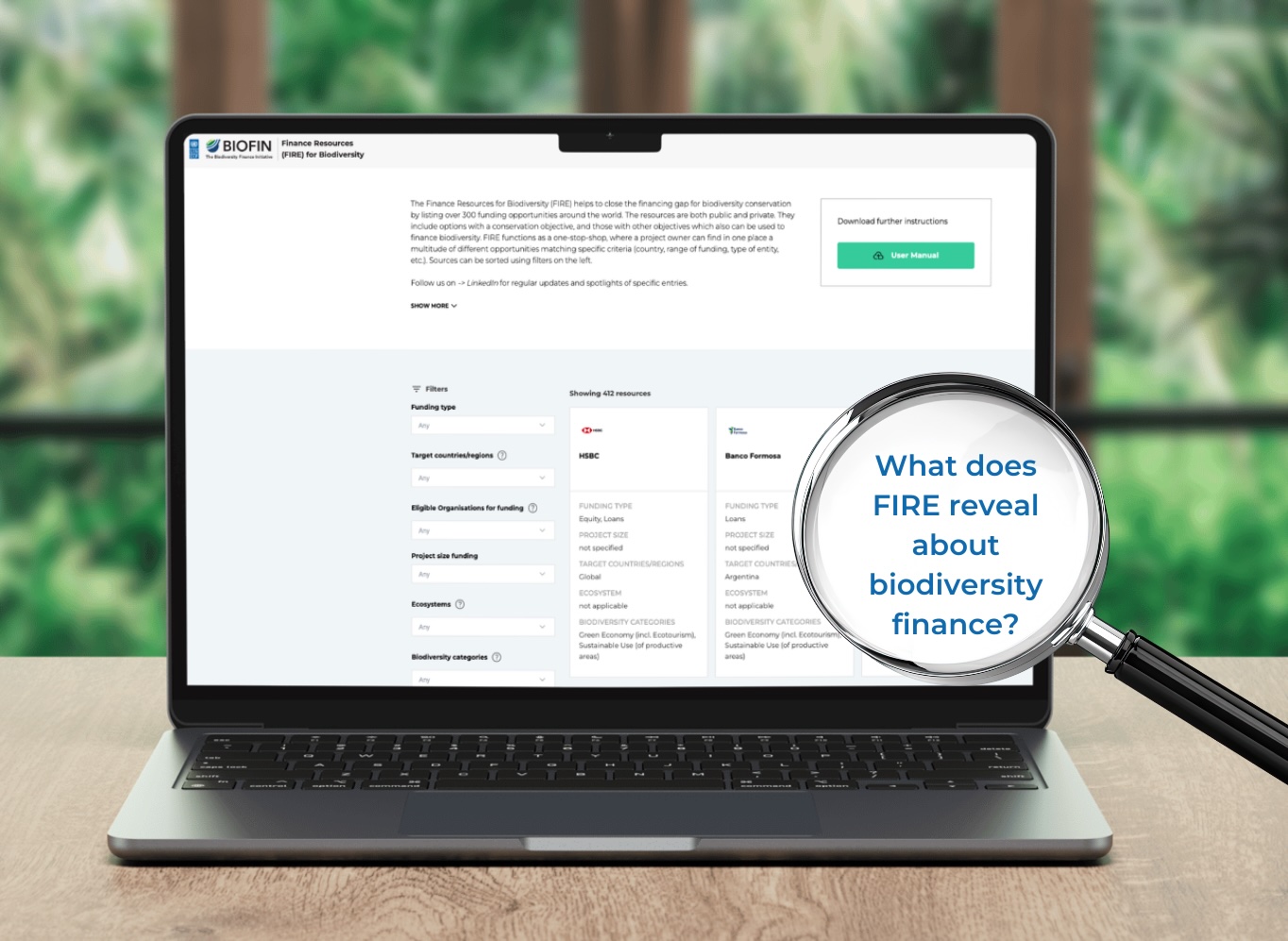
Enhancing access to means of implementation, and especially financial resources, is the explicit purpose of BIOFIN’s Financial Resources for Biodiversity Platform (FIRE). The platform features over 430 resources representing grants, loans, equity, fellowships, and scholarships, and can be customized by country, funding type and amount, ecosystem, type of biodiversity-related activity, and even relevance for Indigenous Peoples, local communities, women, and/or youth. Find out more in our latest insights of “Unlocking biodiversity finance for women through FIRE”, “A Guide for Youth-led Biodiversity Projects” and “Funding for Indigenous Peoples and local communities: Value, Challenges and Funding Examples”.